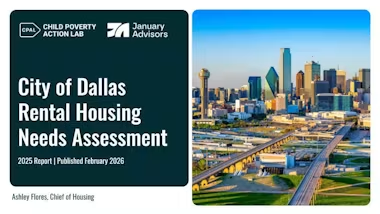
2025 Rental Housing Needs Assessment
February 2026
This is the third annual edition of this report. See past reports:
This year’s report is anchored by four core insights:
1) It’s hard to be a renter in Dallas. Of the 304K renter households in Dallas, 59% are low income (≤80% Area Median Income) and 50% are cost burdened, meaning they spend more than 30% of their gross income on housing.
2) There is a shortage of affordable rental units for very low-income households. For households that earn at or below 50% AMI ($52K for a family of four), the City of Dallas is short 46K affordable rental units — for every 100 households ≤50% AMI, there are just 60 affordable rental units.
3) Dallas is changing. In the past 10 years, Dallas has realized significant growth in the population of seniors (+33%), one- and two-person households (+23% and +19%, respectively), and high-income households earning more than $150K annually (+130%). This rapid growth, however, is juxtaposed with a slight decline (-0.8%) in the population of children, a small increase in households with three or more people (+2%), and a significant decrease in households earning less than $35K (-32%).
4) There are signs of progress, but progress is uneven. After record-high rent growth during the pandemic, renters have recently felt some relief: year-over-year rent growth was largely flat or down slightly in the City of Dallas in 2024 and 2025. An estimated 8,400 multifamily units were delivered in 2024 — 84% market-rate units and 16% income-restricted units. In the past 10 years, educational attainment and household income have both improved significantly, but long-standing inequities persist, and Dallas is the sixth most segregated large city in the U.S.
To achieve a stronger Dallas, housing must be a central issue. Whether your north star is growing the economy, improving the health and wellbeing of Dallas residents, or breaking the cycle of poverty, housing matters.
View more
Role of Junk Fees in the Dallas Rental Housing Market
During summer 2024, CPAL began to explore the role of junk fees in the rental housing market in Dallas.
- 56 out of 60 apartment complexes surveyed charged mandatory monthly fees (i.e., “junk fees”), in addition to the base rent.
- These fees cost renters, on average, $756 to $984 per year, further eroding housing affordability.
An Underutilized Housing Affordability Tool: Homestead Exemptions
CPAL examines homestead exemption access in Dallas County — who’s claiming, who isn’t, and how much money eligible homeowners could realize if they claimed this...
- ~57K residential properties in Dallas County may be eligible for the homestead exemption but have not yet claimed it, for an estimated total benefit of ~$310M.
- ~40K properties in low-income and very low-income census tracts in Dallas County may be eligible for the homestead exemption but have not yet claimed it, for an estimated total benefit of ~$200M, or ~$5,000 per household.
- While an estimated 95% of eligible households in high-income census tracts claim their homestead exemption, only 81% of households in very low-income census tracts claim their homestead exemption.

Mayor's Task Force on Safe Communities
This 2019 report provides recommendations on non-law enforcement solutions to crime and violence in Dallas.
- Philadelphia’s blight remediation program reduced firearm assaults by 39%--a relatively low-cost intervention that is backed by empirical evidence that can be implemented in Dallas.
- New York’s targeted lighting pilot reduced nighttime index crimes by 36% and generated a 3x ROI. This can be replicated in Dallas by using tower lighting or expanding LED lighting in micro-geographies with high incidence of crime and low lighting.