

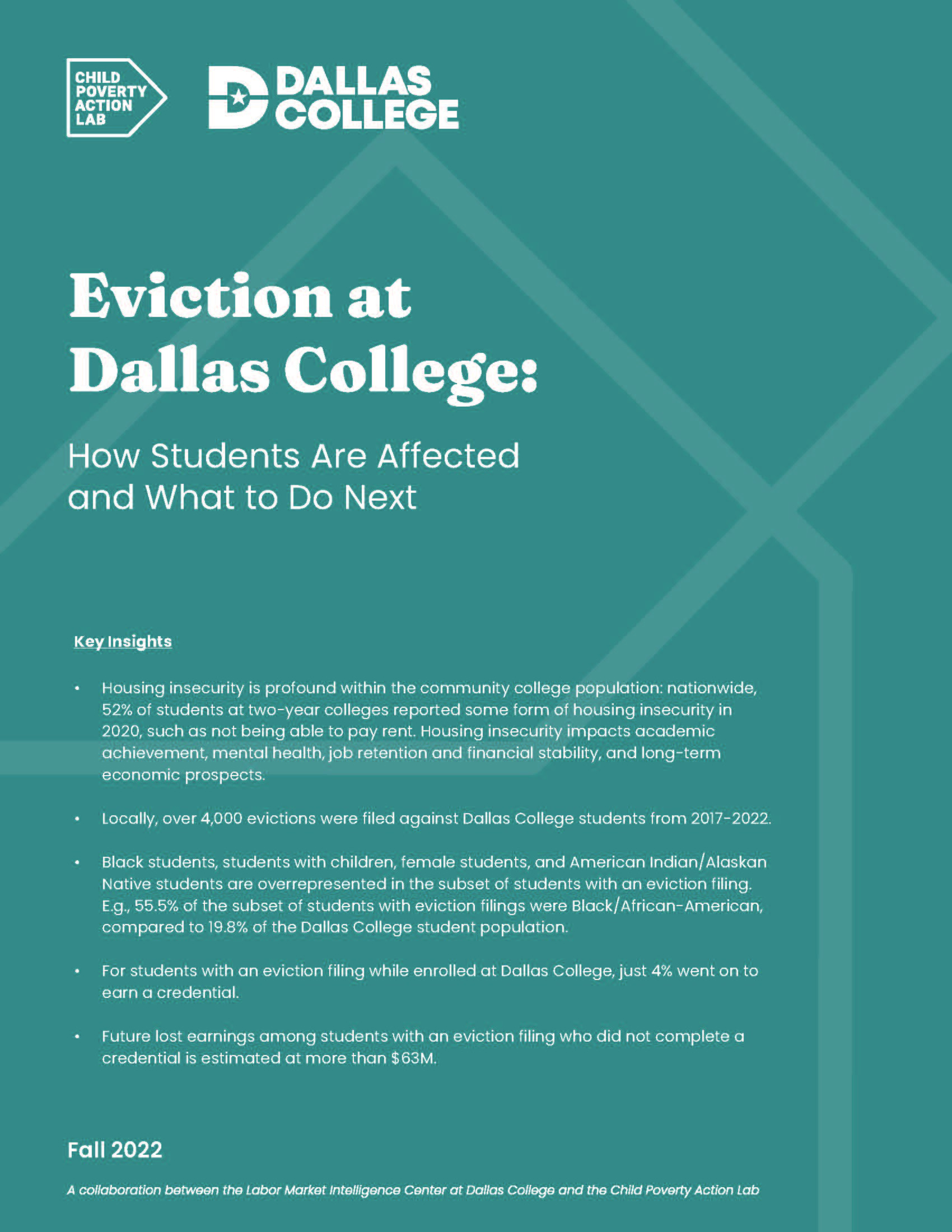
Eviction at Dallas College
Housing insecurity is profound within the community college population: nationwide, 52% of students at two-year colleges reported some form of housing insecurity in 2020, such as not being able to pay rent. Housing insecurity impacts academic achievement, mental health, job retention and financial stability, and long-term economic prospects.
This analysis from CPAL and Dallas College explores how eviction affects Dallas College students and opportunities for support.
View more

2025 Rental Housing Needs Assessment
The 2025 Rental Housing Needs Assessment establishes a shared fact base on rental affordability, supply, and opportunity in the City of Dallas.
- Dallas faces a 46,000-unit shortage of rental homes affordable to very low-income households earning ≤50% of Area Median Income (AMI). Since CPAL first published this report in 2023, the gap has grown by more than 12,000 units.
- Between 2021 and 2023, the number of rental units priced below $1,000 per month was cut in half — a loss of over 50,000 units. Today, 90% of affordable units for low-income renters are unsubsidized and vulnerable to market pressures.
- Half of all renters spend more than 30% of their income on housing, including 75% of single parents with children and 65% of senior renters. Extremely low-income renters spend, on average, 78% of their income on housing, leaving little room for other necessities.


When parents go to jail, children are the hidden victims
Dallas County has more children with parents behind bars than any of its peers across Texas.
- As many as 100,000 children a year in Dallas have parents behind bars. These children have a much higher risk of aggression and antisocial behavior, suspension and expulsion, depression, anxiety, substance abuse, suicide, and incarceration.
- With people of color representing 8 out of 10 of the incarcerated, Black and Latino children are disproportionately affected. They are 7.5 times and 2.3 times more likely than white children, respectively, to have had an incarcerated parent.

WIC Playbook
CPAL’s WIC playbook features prototypes designed to increase WIC benefit uptake in Dallas through human-centered design.
- The WIC program plays an important role in improving birth outcomes and containing health care costs. Every dollar spent on WIC leads to savings in health care costs from $1.77 to $3.13 within the first 60 days after birth.
- National data shows that in 2021, an average of 12.13 million moms, babies, and young children were eligible for WIC but only 51% actually participated.