
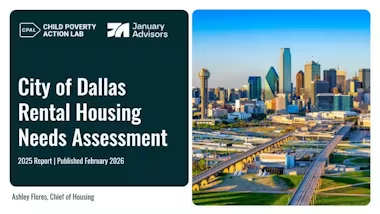
2025 Rental Housing Needs Assessment
February 2026
This is the third annual edition of this report. See past reports:
This year’s report is anchored by four core insights:
1) It’s hard to be a renter in Dallas. Of the 304K renter households in Dallas, 59% are low income (≤80% Area Median Income) and 50% are cost burdened, meaning they spend more than 30% of their gross income on housing.
2) There is a shortage of affordable rental units for very low-income households. For households that earn at or below 50% AMI ($52K for a family of four), the City of Dallas is short 46K affordable rental units — for every 100 households ≤50% AMI, there are just 60 affordable rental units.
3) Dallas is changing. In the past 10 years, Dallas has realized significant growth in the population of seniors (+33%), one- and two-person households (+23% and +19%, respectively), and high-income households earning more than $150K annually (+130%). This rapid growth, however, is juxtaposed with a slight decline (-0.8%) in the population of children, a small increase in households with three or more people (+2%), and a significant decrease in households earning less than $35K (-32%).
4) There are signs of progress, but progress is uneven. After record-high rent growth during the pandemic, renters have recently felt some relief: year-over-year rent growth was largely flat or down slightly in the City of Dallas in 2024 and 2025. An estimated 8,400 multifamily units were delivered in 2024 — 84% market-rate units and 16% income-restricted units. In the past 10 years, educational attainment and household income have both improved significantly, but long-standing inequities persist, and Dallas is the sixth most segregated large city in the U.S.
To achieve a stronger Dallas, housing must be a central issue. Whether your north star is growing the economy, improving the health and wellbeing of Dallas residents, or breaking the cycle of poverty, housing matters.
View more


When parents go to jail, children are the hidden victims
Dallas County has more children with parents behind bars than any of its peers across Texas.
- As many as 100,000 children a year in Dallas have parents behind bars. These children have a much higher risk of aggression and antisocial behavior, suspension and expulsion, depression, anxiety, substance abuse, suicide, and incarceration.
- With people of color representing 8 out of 10 of the incarcerated, Black and Latino children are disproportionately affected. They are 7.5 times and 2.3 times more likely than white children, respectively, to have had an incarcerated parent.

Equity in Bond Planning
This report highlights DISD's efforts to make place-based investments in historically redlined communities with bond funding.
- The bond designated $41 million to create community hubs providing wraparound services in four feeder patterns: Spruce in Pleasant Grove, Lincoln in South Dallas, West Dallas’ Pinkston, and Oak Cliff’s Roosevelt.
- Community Resource Index data across 40 indicators and 5 domains underscore what we know to be true: that these communities have experienced disinvestment as a result of intentional policy-making.

What Can Dallas Do To Motivate Landlords to Accept Housing Vouchers?
CPAL’s new report reveals just how difficult it is for low-income renters to find a rental unit even with government support.
- Only 7% of the surveyed apartment complexes in four counties—Denton, Dallas, Tarrant, and Collin—reported taking Housing Choice Vouchers.
- Within the City of Dallas, voucher holders are overwhelmingly housed in the southern half of the city and are concentrated in a handful of census tracts.